
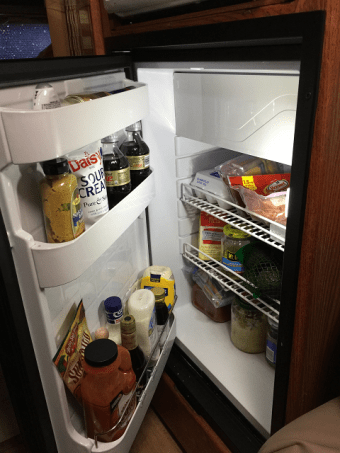
 If there was any one change that transformed Hugo into a viable full time home, it would be the refrigerator upgrade. If I had know how big a difference it would make I’d have done it sooner.
Most RV refrigerators are know as 3-ways. That means they can run on 120v AC, 12v DC, or propane. It’s a really clever setup – you can read more on Wikipedia. On 120v AC, no problem. Unfortunately we only have that when we’re plugged in somewhere. Disconnected your only options are 12v DC and propane. 12V DC really isn’t very useful because of how much power it takes. In fact the B190 is wired such that you can only run the frig on DC when the engine is running. Otherwise it would drain the house batteries in short order. That leaves propane for most situations.
Using propane for refrigeration wasn’t a problem from the supply point of view. It didn’t use much. It’s really the way these refrigerators work that make them a bit temperamental. First they don’t cool very much. Maybe 30 – 40 degrees below outside temperature. When it gets in the 90’s that means your refrigerator may only be in the 50’s. Marginal for food and you can forget ice cubes. Second they’re sensitive to tilt. If the RV is tilted too much, they just stop working. We lost a lot of food to this quirk. I’m sure modern 3-ways are improved but ours needed to be replaced.
After an appropriate Internet search and reviews from the good folks at technomadia.com, we decided on the Vitrifrigo. Our specific model is the C130RBD4-F. I don’t see it on their website anymore but the one I linked to seems to be the same dimensions. It has 4.7 cu ft of storage and operates on 12VDC or 120VAC. It switches between the two voltages automatically so when you plug in it will use AC then revert to DC when you disconnect. Unlike the ammonia absorption process of the 3-way, the Vitrifrigo uses a compressor just like your home refrigerator.
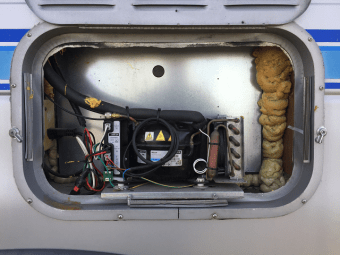 Note that the C130 model comes in two flavors, one with an internal compressor and one with it external. Ours has the external compressor. Because of the curve of the B190’s body, there is a fair amount of space behind the lower part of the refrigerator. Just enough for the compressor. When you’re living in a small RV, every bit of space becomes precious. By having the external compressor we picked up enough extra space in the frig for another 6-pack. It takes a little more work to install since you have to mount the compressor but hey, an extra 6-pack!
In the year and a half we’ve had the Vitrifrigo it has been outstanding. No hiccups, no down time, no lost food. It just works.

 B190 Expedition
Hi Tim!
How does that fridge do in a boondocking situation? What is the power draw on 12v like? What is your onboard battery situation like? Thanks!
LikeLike
It works great. Takes about 5.5A when running. We have about 400ah of storage plus 400w of solar (I’ll do a blog on that someday). We can make 2 -3 cloudy days with that amount of storage.
LikeLike
Thanks for the reply! I installed the same model in my ‘99 B190. I had a bit of trim to remove and a vent pipe to shift in order to get it in but, man, we love it! Thanks for the inspiration.
LikeLike
Did you get the inside, or outside mount?
LikeLike
I got the outside mounted compressor. There is room behind the frig for it and it gives a little more room inside the frig.
LikeLike
I have a 1994 and am considering sliding one of these Vitrifrigo’s in instead of the (broken) stock Dometic. What year is your B190, and did you have to do any cabinet modification to fit it?
LikeLike
Ours is a 1996 and has the pantry above the refrigerator. I took out the exhaust stack and doubled the size of the pantry. That would be optional. There weren’t any cabinet modifications needed to install the refrigerator. It fit right in.
LikeLike
One more question, Tim!
You mentioned the B190 is wired so the 12volt connection only works while the engine is running… How did you change/modify your wiring so the new fridge can run off DC at all times? I have a 1994 B190 where the fridge has never operated, I’m going to be doing an install with the NovaKool R4500 just like shown at https://youtu.be/RfSRsoxON_w
I plan to operate on 12volt almost exclusively, and am trying to figure out how I’ll have to rewire it to operate that way while boondocking, or how easy that change will be? (Running new wires, or just changing the hot-lead in the fuzepanel?)
LikeLike
On mine, the DC positive wire from the refrigerator went to a relay behind the fuse/breaker panel under the sofa. That relay is energized when the engine is running. I took it out so the DC at the frig was hot all the time.
LikeLike
I found the relay… it has a white wire, a green wire, a black, and a yellow. I believe the yellow is the signal wire, letting the relay know if the ignition is on… The green goes into a harness and I think is probably the same green wire that comes out behind the fridge?
What did you do to take the relay out? I’m trying to figure out how to do the same as you. 😉
I’ve posted a similar question at https://www.b190.com/viewtopic.php?f=5&t=3058#p13172 if you’re on those forums as well, instead of blasting your blog with these questions! (and thank you very much for answering them!!)
LikeLike
One of the wires should be hot with the engine off. Wire that to the frig wire. Cap the yellow wire. In my case the hot wire is black and the frig wire is green. I just wired those together with a wire nut. The white wire is just a ground for the relay and isn’t needed. I think I just removed mine.
LikeLike